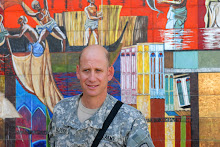
As Sgt. Zoeller reminds me from time to time, we are living the dream. So, what does 'living the dream' mean? It is a phrase that each Army Soldier defines for him/her self.
Sgt. Risner says he has said it plenty of times, but he says, "I've never really given it any thought to what it means!"
Sgt. Burrell has used the phrase often and says it means to him that he is "living what people are dreaming about".
It is a great phrase to say to anyone of higher rank than you when they ask you how you're doing. Generally, it captures the moment.
So, now I have made it a little bit of a habit. How ya doing Spc. Alperin?, "living the dream, Sgt./First Sgt./Mam/Sir, living the dream."
Sgt. Zoeller expresses it well by saying that it means "I'm not sitting in a cubicle, I'm not picking up trash, and I'm not doing taxes."
Sgt. Zoeller says he stole 'living the dream' from Sgt. Taylor. Sgt. Taylor says for him the phrase 'Living the dream' replaced another catchy Army response to the question of how ya' doing, 'phenomenal'.
Anyway you look at it, while in the Army, 'Living the dream' is an optimistic outlook on your day.
Friday, January 23, 2009

Realism dominates Heat instruction
 FORT DIX, N.J. – Extend to your left, and stretch. Warm-up exercises as part of Physical Training continue everyday for Soldiers here at Fort Dix. Soldiers take part in these exercises in order to get their bodies ready for a good workout. But, Soldiers doing warm-up exercises in battle rattle, including Individual Body Armor and Helmet with eye protection is definitely not the norm.
It’s all part of the class HEAT (Humvee Egress Assistance Trainer), which takes Soldiers through a simulated HMMWV (Humvee) rollover. The class is intensely physical, requiring Soldiers to exit a Humvee simulator from an upside down position so that they can prepare for any real-life rollovers that may happen during their deployment.
“They need to be loose before they get in the simulator,” said Staff Sgt. Lamonte Thomas Sr., HEAT instructor, from Colonial Heights, Va. of the 72nd Field Artillery Brigade of A.P. Hill, Va.
Due to the nature of the training, instructors must focus Soldiers on handling both the physical and psychological elements involved in getting out of the vehicle. Instructors teach how to handle Humvee rollovers and the aftermath of a rollover incident.
The training begins with classroom instruction, and takes Soldiers through a process that covers all the basics for getting out safely from all positions, including driver, team captain, right and left rear seats and the gunner’s position.
By the end of training, after Soldiers have successfully exited the simulator, added emphasis is placed on what to do and the positioning of Soldiers outside of the rollover.
“We call it muscle memory,” said Sgt. Ted Vega, HEAT instructor, from Escondido, Ca. also of the 72nd Field Artillery Brigade of A.P. Hill, Va. “In case of an accident, Soldiers must know procedures. There must be accountability.”
The aftermath also includes having Soldiers react to enemy fire, Improvised Explosive Devices, and caring for the wounded.
“In case someone goes down, they need to know what to do, including the nine-line medivac,” said Vega.
Instructors are dealing with different levels of knowledge when it comes to riding in Humvees.
“Soldiers who have never rode in a Humvee before are not aware of the dangers a rollover can cause,” said Thomas.
HEAT began soon after the war in Iraq started, said Thomas. It was due to the high amount of IED’s encountered by Soldiers.
Thomas has been an instructor here for two years and he also taught for 4 months at Camp Baring in Kuwait. He knows that HEAT makes a difference and keeps Soldiers prepared for the worst.
In reference to a rollover accident here in September of last year, Thomas said, “Soldiers knew what to do. This made us feel that we are helping Soldiers and that the training is realistic.”
In Iraq and Afghanistan, unfortunately, it’s not just the IED’s, the terrain also makes a difference.
“You can roll over by hitting a sand pocket going 25 miles per hour,” said Thomas.
HEAT is evolving, too. New to the simulator are combat door locks. These are the same combat door locks that are part of the Up-armored Humvees. These are heavy, equipment laden Humvees.
HEAT is evolving, too. New to the simulator are combat door locks. These are the same combat door locks that are part of the Up-armored Humvees. These are heavy, equipment laden Humvees.
“Up-armored Humvees are more dangerous than regular Humvees,” said Thomas.
Thomas and Vega take pride in providing the most realistic instruction possible. They know the importance that HEAT has in preparing Soldiers for deployment. Making Soldiers aware of what to do in a rollover is their goal.
“Having all the information they need to keep them safe is the key, said Vega. I’ve been over there, I can give my input to help get them ready.”
First, 30 degrees to the left, then it’s 30 degrees to the right, two full rotations later and now it’s gravity’s turn as the simulator goes into full effect. Soldiers are yelling instructions to each other and reaching for the seatbelt, gunner’s release, or combat door lock all in an effort to egress and get to a secure position outside of the simulator. It’s a time for Soldiers to be expedient and proficient when their senses might be telling them otherwise. It feels completely unnatural, but it’s a Soldier’s reality.
HEAT is a whole humvee rollover experience taught by knowledgeable, passionate instructors. HEAT involves a multitude of tasks for Soldiers that requires an active mind, a sound stomach, and a limber body. PT uniforms are not allowed.
Photo Caption: Sgt. Ted Vega, HEAT instructor, from Escondido, Ca. of the 72nd Field Artillery Brigade of A.P. Hill, Va. takes Soldiers through a series of warm-up exercises prior to Soldiers entering the Humvee simulator. Vega begins with neck exercises and works his way down the body as Soldiers follow his lead.
Proactive COIN sets behavior standards
FORT DIX, N.J.-- Counter Insurgency (COIN) is a working priority and a theme that is being repeated during mobilization training here. It is the standard operating procedure for Soldiers currently active in and deploying to countries which have insurgents. These daily laws to follow are priority for the Iraqi soldiers as well.
Training here for mobilizing Soldiers emphasizes COIN through classes, briefings, lectures and discussions. Training inside the classroom is complimented with plenty of real-life training outside the classroom. Soldiers are engaged in convoys, night fire exercises, land navigation, and plenty of urban environment training.
“War is routine, and then it is terror,” said Lt. Col. Charles P. McCormick, commander of the 332nd Ordinance Battalion, from Redhouse, W.Va. “Soldiers can’t be listening to IPoDs in the gunner’s hatch, and they must always apply the 5 (meters) to 25 (meters) watch. They must look out for any changes of behavior in the population.”
Guarding against complacency and trying not to set patterns are major elements of COIN according to McCormick. He adds that living among the Iraqi people is the basis for COIN and working with the host country is the key.
“No longer are we in a sterile environment, “ said McCormick. “The Army has done an excellent job replicating what it’s like over there. In fact, we are even employing displaced Iraqis as trainers who talk to troops to give real-life experiences.”
McCormick is getting ready for his third deployment to the region. He is working closely with his command sergeant major, who is also preparing for his third deployment to the region, to engage his battalion in COIN-related operations.
COIN allows the leadership to get a better idea of what is out there, said Command Sgt. Maj. Johnny M. McPeek, from Kingsport, Tenn. Preparing the Soldiers to report what they see, changes they see, and any high-value targets to watch are all part of training Soldiers as sensors.
Iraqi soldiers and American Soldiers have trained together to form Military Transition Teams. McPeek has firsthand experience as part of a MiTT, and has additional experience as a graduate from the COIN Center For Excellence in Camp Taji, Iraq, which serves both U.S. Soldiers and Iraqi Security Forces.
“Iraqi soldiers are liaisons,” said McPeek. “We utilize the ISF to use as an assessment of our surroundings.”
McPeek indicated that information gathered by ISF was pretty accurate. It is has been an adjustment for troops to count on information from ISF, but they have used it to their advantage, said McPeek.
A significant byproduct of successful COIN is the ability of Iraqis to work together on teams that include Shiites and Sunnis. Soldiers have made significant strides in mending fences between these groups, according to McCormick.
McCormick says that Iraq is turning more toward what America represents. “It’s the right of all people to worship as they see fit,” said McCormick.
McCormick adds that COIN contributes to helping Iraqis see that tolerance of all religions and points of view can coexist.
 Counter Insurgency (COIN) is a working priority and a theme that is being repeated during mobilization training here. It is the standard operating procedure for Soldiers currently active in and deploying to countries which have insurgents. These daily laws to follow are priority for the Iraqi soldiers as well.
 Training here for mobilizing Soldiers emphasizes COIN through classes, briefings, lectures and discussions. Training inside the classroom is complimented with plenty of real-life training outside the classroom. Soldiers are engaged in convoys, night fire exercises, land navigation, and plenty of urban environment training.
“War is routine, and then it is terror,” said Lt. Col. Charles P. McCormick, commander of the 332nd Ordinance Battalion, from Redhouse, W.Va. “Soldiers can’t be listening to IPoDs in the gunner’s hatch, and they must always apply the 5 (meters) to 25 (meters) watch. They must look out for any changes of behavior in the population.”
Guarding against complacency and trying not to set patterns are major elements of COIN according to McCormick. He adds that living among the Iraqi people is the basis for COIN and working with the host country is the key.
“No longer are we in a sterile environment, “ said McCormick. “The Army has done an excellent job replicating what it’s like over there. In fact, we are even employing displaced Iraqis as trainers who talk to troops to give real-life experiences.”
McCormick is getting ready for his third deployment to the region. He is working closely with his command sergeant major, who is also preparing for his third deployment to the region, to engage his battalion in COIN-related operations.
COIN allows the leadership to get a better idea of what is out there, said Command Sgt. Maj. Johnny M. McPeek, from Kingsport, Tenn. Preparing the Soldiers to report what they see, changes they see, and any high-value targets to watch are all part of training Soldiers as sensors.
Iraqi soldiers and American Soldiers have trained together to form Military Transition Teams. McPeek has firsthand experience as part of a MiTT, and has additional experience as a graduate from the COIN Center For Excellence in Camp Taji, Iraq, which serves both U.S. Soldiers and Iraqi Security Forces.
“Iraqi soldiers are liaisons,” said McPeek. “We utilize the ISF to use as an assessment of our surroundings.”
McPeek indicated that information gathered by ISF was pretty accurate. It is has been an adjustment for troops to count on information from ISF, but they have used it to their advantage, said McPeek.
A significant byproduct of successful COIN is the ability of Iraqis to work together on teams that include Shiites and Sunnis. Soldiers have made significant strides in mending fences between these groups, according to McCormick.
McCormick says that Iraq is turning more toward what America represents. “It’s the right of all people to worship as they see fit,” said McCormick.
McCormick adds that COIN contributes to helping Iraqis see that tolerance of all religions and points of view can coexist.
“I had Sunnis and Shiites in the same battalion; by the end of the mission’s year, they came together as a collective unit,” said McPeek. “One team, one fight, I’ve lived it and I’ve seen it.”
COIN is a way of life. It is a lifestyle that works by being proactive, vigilant and patient. It is the fabric of the current mission, Operation Iraqi Freedom. COIN means to always be aware of the surroundings and to report any and all suspicious activities that could interrupt progress of the growing infrastructure of the host nation or to inflict violence. McCormick and McPeek are prime examples of Soldiers living, training and working daily toward making all Soldiers more aware of where COIN fits in the framework of the Global War on Terror.
Photo Caption: Commander Lt. Col. Charles P. McCormick, Redhouse, W.V. and Command Sgt. Maj. Johnny M. McPeek, Kingsport, Tn. of the 332nd Ordinance Battalion out of Kenova, W.V. stand together in front of both the U.S. and Iraq flags to show support and solidarity for the newly formed Iraq government. McCormick and McPeek are leading the efforts to strengthen COIN among Soldiers. “Every Soldier is a sensor. Soldiers must have situational awareness. They must know the surroundings. They must be on watch. They must look for patterns and changes in patterns,” said McCormick.
Thursday, December 18, 2008
Soldiers lead physical training for the first time
They resemble the quintessential female athletes of this generation. Their bodies are well-proportioned, seemingly transported from Hellenistic Greek times. Their robust, trim, chiseled frames inspire both awe and admiration. Leading the unit in an Army Physical Training session, no problem, right?
“I was kind of scared,” said Pfc. Laura L. Johnson.
“I felt overwhelmed,” said Spc. Ashley M. Anderson.
Anderson and Johnson both came from athletic backgrounds prior to joining the Army. Anderson was a varsity athlete in three sports in high school and played volleyball in college. Johnson is a former kickboxing champion accustomed to grappling and weight-training. Both have recently been selected for leading Army PT for the first time.
Johnson counted on the support and guidance of Staff Sgt. Peter A. Ford for her first leadership PT session.
“Sgt. Ford helped prepare me”, Johnson said. “We went through the manuals together online to make sure the session was done correctly.”
For Johnson, there is no substitute for being in front of this formation. In the 211th, she is the most junior soldier deploying with the unit. She said there is plenty of anxiety leading a formation, but it is even more amplified when everyone outranks you.
Anderson was assisted by Staff Sgt. Mark C. Burrell for her first leadership PT session. He had her read a one-hundred page physical fitness manual in order to prepare. She said that once she realized the expectations, she was comfortable with the task.
“I wanted to make sure I got all the commands right,” Anderson said. “I wanted to run a well-organized session and prove to the rest of the group that I could lead PT.”
Interestingly, both Anderson and Johnson did something special for their first time leadership PT sessions. They were innovators, trying to keep the unit involved and enthusiastic through a muscle-strength fitness training regiment.
Johnson used circle training to take the group through grass drills and guerilla drills. Both drills focus on mobility and flexibility and take Soldiers through a series of exercises. Later, she incorporated relays into the session. It was a success. According to Ford, there were many in the unit who felt proud of Johnson, yet were too tired to express their true feelings.
Anderson carefully planned a workout session using station circuit training where Soldiers exercised for two minutes and then moved on to the next station. She explained each exercise and labeled them on the field so that Soldiers would know what to do. According to Burrell, her session went extraordinarily well. Soldiers felt the pain of working different muscle groups and none of them suffered any ant bites.
Anderson and Johnson have expressed confidence in knowing the commands for all the warm-up exercises, stretches and calisthenics and are eagerly anticipating their next PT assignment. They said that they are feeling like established veterans when it comes to leading PT.
According to Burrell and Ford, both Anderson and Johnson have done a solid job in their PT leadership roles.
Anderson and Johnson are used to sculpting their bodies like fine-tuned machines. As leaders of PT, they are helping Soldiers see how a well-oiled machine operates. This development in their lives is a big change from their past athletic achievements.
“It’s organized exercise and there’s no real competition,” Anderson said.
“I’m used to doing training barefoot,” Johnson said.
The 211th has a PT test Saturday December 20th. Best of luck to all who are participating and don’t forget to thank Anderson and Johnson for the motivation.
“I was kind of scared,” said Pfc. Laura L. Johnson.
“I felt overwhelmed,” said Spc. Ashley M. Anderson.
Anderson and Johnson both came from athletic backgrounds prior to joining the Army. Anderson was a varsity athlete in three sports in high school and played volleyball in college. Johnson is a former kickboxing champion accustomed to grappling and weight-training. Both have recently been selected for leading Army PT for the first time.
Johnson counted on the support and guidance of Staff Sgt. Peter A. Ford for her first leadership PT session.
“Sgt. Ford helped prepare me”, Johnson said. “We went through the manuals together online to make sure the session was done correctly.”
For Johnson, there is no substitute for being in front of this formation. In the 211th, she is the most junior soldier deploying with the unit. She said there is plenty of anxiety leading a formation, but it is even more amplified when everyone outranks you.
Anderson was assisted by Staff Sgt. Mark C. Burrell for her first leadership PT session. He had her read a one-hundred page physical fitness manual in order to prepare. She said that once she realized the expectations, she was comfortable with the task.
“I wanted to make sure I got all the commands right,” Anderson said. “I wanted to run a well-organized session and prove to the rest of the group that I could lead PT.”
Interestingly, both Anderson and Johnson did something special for their first time leadership PT sessions. They were innovators, trying to keep the unit involved and enthusiastic through a muscle-strength fitness training regiment.
Johnson used circle training to take the group through grass drills and guerilla drills. Both drills focus on mobility and flexibility and take Soldiers through a series of exercises. Later, she incorporated relays into the session. It was a success. According to Ford, there were many in the unit who felt proud of Johnson, yet were too tired to express their true feelings.
Anderson carefully planned a workout session using station circuit training where Soldiers exercised for two minutes and then moved on to the next station. She explained each exercise and labeled them on the field so that Soldiers would know what to do. According to Burrell, her session went extraordinarily well. Soldiers felt the pain of working different muscle groups and none of them suffered any ant bites.
Anderson and Johnson have expressed confidence in knowing the commands for all the warm-up exercises, stretches and calisthenics and are eagerly anticipating their next PT assignment. They said that they are feeling like established veterans when it comes to leading PT.
According to Burrell and Ford, both Anderson and Johnson have done a solid job in their PT leadership roles.
Anderson and Johnson are used to sculpting their bodies like fine-tuned machines. As leaders of PT, they are helping Soldiers see how a well-oiled machine operates. This development in their lives is a big change from their past athletic achievements.
“It’s organized exercise and there’s no real competition,” Anderson said.
“I’m used to doing training barefoot,” Johnson said.
The 211th has a PT test Saturday December 20th. Best of luck to all who are participating and don’t forget to thank Anderson and Johnson for the motivation.
Wednesday, December 10, 2008
Soldier stays in top form with public affairs duties

His recruiter wanted him to be a fire direction control specialist, someone who determines the trajectory of rounds needed to hit targets coming from various weapons. But, the 24-year old from Bountiful, Utah, knew that working with angles associated with artillery were not the kind of angles best suited for him. He wanted to be a journalist and tell the stories of fire direction control specialists. Fortunately, the recruiter found a position at the 426th Medical Unit in Salt Lake City, and Anthony J. Martinez found his calling.
These days, 1st Sgt. Martinez is training for another deployment to Baghdad, Iraq. His schedule has temporarily taken him away from a position at the U.S. Army Reserve Command Headquarters in Washington, D.C.
Prior to his present assignment with the 211th Mobile Public Affairs Detachment in Bryan, Texas, Martinez participated as an integral part of the Army Reserve Command’s public affairs training and readiness branch. His assignment to the branch in 2006 came after more than 18 years as an Army public affairs specialist.
His wide-ranging public affairs services include: news writing, photojournalism, feature story writing, speeches, media relations, community relations, and broadcast news audio and video stories.
After returning from deployment and coming back to the Army Reserve Command, Martinez will continue to spend his time working on training regiments for all Army Reserve public affairs units. Martinez oversees operations and resources available that prepare Soldiers for public affairs missions. His biggest goal with the command center is to help establish more networking between PA units so that they are sharing lessons learned in the field.
Giving credit and providing coverage to servicemembers and to their accomplishments is what public affairs is all about, said Martinez. He added, “People back home can say that’s my son, my dad, my brother, my sister.”
Martinez has had an affinity for news and current events his whole life. “As a kid, I loved National Geographic articles,” he said. It is the process of getting the interview and capturing the story, using words and pictures, that keeps his focus.
Top is an unofficial greeting that is only attached to first sergeants. Soldiers from all over the world use it affectionately.
One of Top’s stories he fondly recalls was during a previous deployment in Iraq. He covered a former Army truck driver turned robotic repair specialist. Somebody discovered this Soldier had a knack for more than truck driving, and Top revealed that he had the specific responsibility for detonating bombs. Top said it was a nice surprise for the Soldier to be interviewed.
Martinez says he is right where he wants to be. He is happy with the progress of the 211th, and he is looking forward to covering more Soldiers’ stories. He works all the angles and continues to search for that keen story which tells what life is like being an Army fire direction control specialist.
These days, 1st Sgt. Martinez is training for another deployment to Baghdad, Iraq. His schedule has temporarily taken him away from a position at the U.S. Army Reserve Command Headquarters in Washington, D.C.
Prior to his present assignment with the 211th Mobile Public Affairs Detachment in Bryan, Texas, Martinez participated as an integral part of the Army Reserve Command’s public affairs training and readiness branch. His assignment to the branch in 2006 came after more than 18 years as an Army public affairs specialist.
His wide-ranging public affairs services include: news writing, photojournalism, feature story writing, speeches, media relations, community relations, and broadcast news audio and video stories.
After returning from deployment and coming back to the Army Reserve Command, Martinez will continue to spend his time working on training regiments for all Army Reserve public affairs units. Martinez oversees operations and resources available that prepare Soldiers for public affairs missions. His biggest goal with the command center is to help establish more networking between PA units so that they are sharing lessons learned in the field.
Giving credit and providing coverage to servicemembers and to their accomplishments is what public affairs is all about, said Martinez. He added, “People back home can say that’s my son, my dad, my brother, my sister.”
Martinez has had an affinity for news and current events his whole life. “As a kid, I loved National Geographic articles,” he said. It is the process of getting the interview and capturing the story, using words and pictures, that keeps his focus.
Top is an unofficial greeting that is only attached to first sergeants. Soldiers from all over the world use it affectionately.
One of Top’s stories he fondly recalls was during a previous deployment in Iraq. He covered a former Army truck driver turned robotic repair specialist. Somebody discovered this Soldier had a knack for more than truck driving, and Top revealed that he had the specific responsibility for detonating bombs. Top said it was a nice surprise for the Soldier to be interviewed.
Martinez says he is right where he wants to be. He is happy with the progress of the 211th, and he is looking forward to covering more Soldiers’ stories. He works all the angles and continues to search for that keen story which tells what life is like being an Army fire direction control specialist.
Tuesday, December 9, 2008
News and Notes...
The first all Specialist (Spc.) meeting was held December 6th at the EZ motel. All Specialists were present with the exception of Specialist Mitchell. We looked for you Spc. Mitchell, but, apparently, you were incognito or indecently exposed.
The meeting went off without a hitch. The agenda included picking officers and then following up with 'how you feel' questions.
Toilet paper was used in order to distinguish who's turn it was to talk. Spc. Logue said, "Let's roll with it!" The teepee took the place of the shield.
Spc. Anderson was elected President of the all Specialist club, with Spc. Soles elected as Treasurer and Spc. Alperin elected as scribe. Spc. Soles plans on watching carefully how much money is spent on tips when we go out to eat.
With regard to the question of how specialists are treated, there were varied responses. Spc. Anderson said, "I have to prove myself around people who don't know me." Spc. Anderson, later in the meeting, could be heard saying, "They need to know when to take our advice!"
When referring to the role of Specialist in Iraq, Spc. Soles said, Specialists do the grunt work. They are the gatherers who find and document.
Spc. Fardette added some wisdom as well, saying, "Ask not what you can do for your sergeants, ask what they can do for you!"
The clandestine specialist motto was created during this meeting and all the specialists who attended the first all specialist meeting ended up at Rudy's for spectacular Texas Bar-b-que. It was a night to remember.
Spc. Alperin summed things up well, "The great thing about this meeting is that no matter what you say, if you start your sentence with the first word as Specialist, your golden."
The meeting went off without a hitch. The agenda included picking officers and then following up with 'how you feel' questions.
Toilet paper was used in order to distinguish who's turn it was to talk. Spc. Logue said, "Let's roll with it!" The teepee took the place of the shield.
Spc. Anderson was elected President of the all Specialist club, with Spc. Soles elected as Treasurer and Spc. Alperin elected as scribe. Spc. Soles plans on watching carefully how much money is spent on tips when we go out to eat.
With regard to the question of how specialists are treated, there were varied responses. Spc. Anderson said, "I have to prove myself around people who don't know me." Spc. Anderson, later in the meeting, could be heard saying, "They need to know when to take our advice!"
When referring to the role of Specialist in Iraq, Spc. Soles said, Specialists do the grunt work. They are the gatherers who find and document.
Spc. Fardette added some wisdom as well, saying, "Ask not what you can do for your sergeants, ask what they can do for you!"
The clandestine specialist motto was created during this meeting and all the specialists who attended the first all specialist meeting ended up at Rudy's for spectacular Texas Bar-b-que. It was a night to remember.
Spc. Alperin summed things up well, "The great thing about this meeting is that no matter what you say, if you start your sentence with the first word as Specialist, your golden."
Monday, December 1, 2008
Treats and delicacies...
Training continues in Bryan/College Station, Texas and we are covering as many areas as possible. Training has been fun and educational because we always have soldiers in the unit that keep things light, but focused.
We have been keeping up with our public affairs guidance and doctrine which maintains our energies towards the mission. Mainly, we are trying to prepare for when we hit ground in Iraq, so that we are ready to cover the stories.
Our physical training continues as well. We are using the Bryan High School track to workout and keep our bodies fit. We do plenty of muscle failure and cardio activities.
But, the Golden Corral has been a major obstacle to keeping the weight down. The Golden Corral Buffet & Grill (GCBG) is our dining facility for lunch and dinner. The 'Corral', as many in the unit put it, is a cornucopia of tastes that leads to a cornucopia of smells later on.
Getting back to the room at the www.eztravelinn.com is always a big relief. Good times are had at the EZ where you can sit back, relax, and watch cable tv or just kick it with a battle buddy and listen to music. The EZ has lived up to its reputation by making our lives much easier. They have even given us gift baskets that include shaving kits, toothpaste, deodorants and peanuts.
We have been keeping up with our public affairs guidance and doctrine which maintains our energies towards the mission. Mainly, we are trying to prepare for when we hit ground in Iraq, so that we are ready to cover the stories.
Our physical training continues as well. We are using the Bryan High School track to workout and keep our bodies fit. We do plenty of muscle failure and cardio activities.
But, the Golden Corral has been a major obstacle to keeping the weight down. The Golden Corral Buffet & Grill (GCBG) is our dining facility for lunch and dinner. The 'Corral', as many in the unit put it, is a cornucopia of tastes that leads to a cornucopia of smells later on.
Getting back to the room at the www.eztravelinn.com is always a big relief. Good times are had at the EZ where you can sit back, relax, and watch cable tv or just kick it with a battle buddy and listen to music. The EZ has lived up to its reputation by making our lives much easier. They have even given us gift baskets that include shaving kits, toothpaste, deodorants and peanuts.
Subscribe to:
Posts (Atom)